
Pachisi
An offline Pachisi game for Android, with cowrie shells and local multiplayer.
- Free, with ads
- No account
- Works offline
- English & हिन्दी

Pachisi brings the traditional Indian board game to your Android phone. Throw six cowrie shells, choose which pieces to move, and bring them home on an exact count. Safe castles and doubled pieces make each turn a choice between advancing, protecting a piece and capturing an opponent. Play against easy, medium or hard computer opponents, or share one phone with friends. Every game mode works offline.





A Pachisi board game you can take anywhere
Start a match on your phone without creating an account. Pachisi is free to download on Google Play and supported by ads. The board, computer opponents and lessons work without an internet connection, so you can play while travelling or away from Wi-Fi.
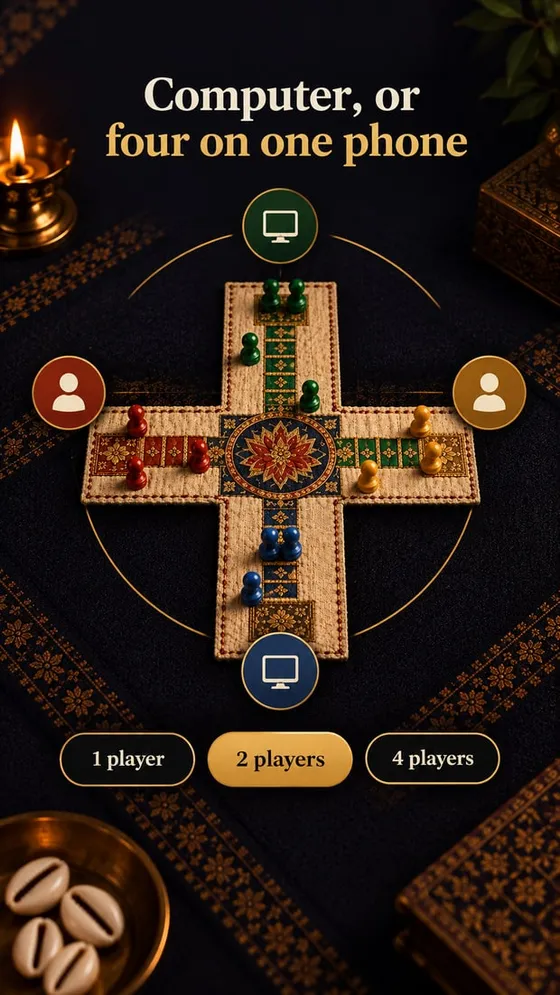
- Play solo against the computer at easy, medium or hard difficulty. Choose the challenge when you start a match.
- Share one device with two players, or play four-player matches in two teams of two. This is local multiplayer on the same phone, rather than online room play.
- Switch between English and Hindi. Labels, lessons and game controls follow your selected language.
- Leave a match and return later. The app keeps the board position and the current turn so you can continue your saved game.
Learn the rules on the board
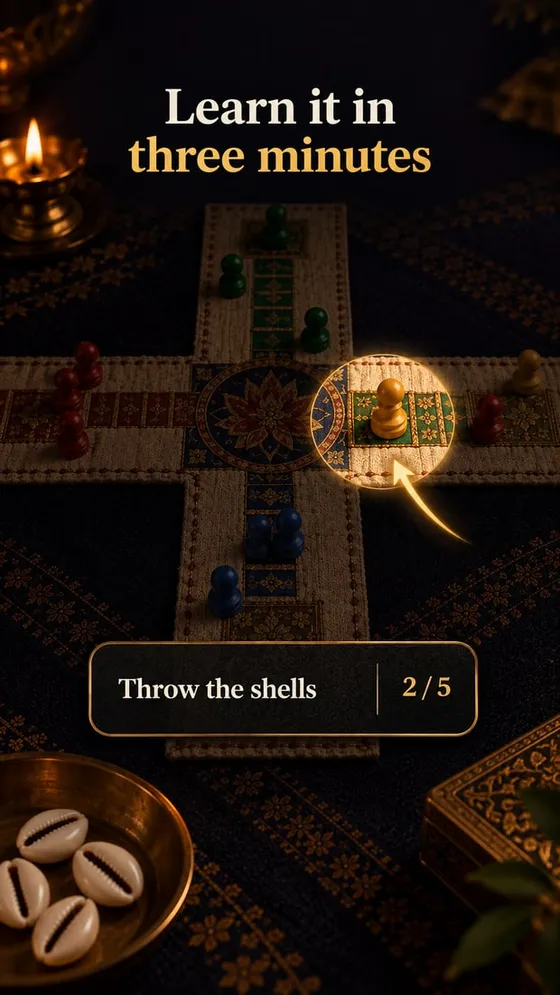
You do not need to know Pachisi before your first game. Five guided lessons introduce shell throws, castles, capturing, the route home and doubled pieces through moves on the board. Start with the lessons, then try an easy computer match to practise the decisions at your own pace.
Pachisi rules vary between households and regions. The rules below describe the version implemented in this app, so you can see how its throws, safe squares and paired pieces work before downloading.
How to play Pachisi with cowrie shells
| Shells landing mouth-up | You move |
|---|---|
| 2, 3, 4, 5 or 6 | that many |
| 1 | 10 - throw again |
| 0 | 25 - the pachis the game is named for - throw again |
A 6, 10 or 25 is a grace: another throw, and a new pawn may enter. Throws stack up and are spent one at a time, each moving one pawn. Three identical graces in a row and the whole turn is wiped.
Offline play, local multiplayer and guided lessons
- Six cowrie shells, thrown the way the game was actually played - no dice, no Ludo shortcuts.
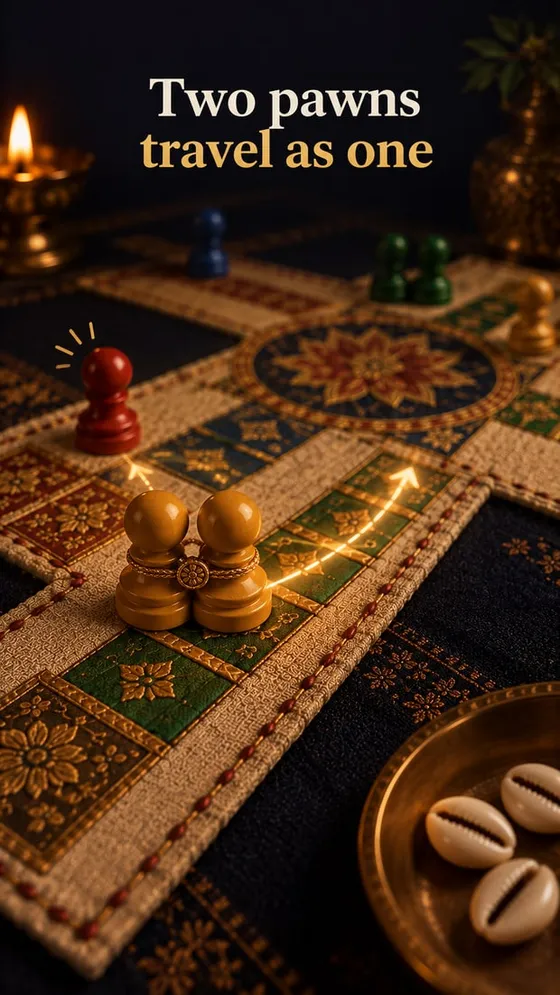
- The real ruleset: castles, grace throws, and doubled pieces that must move as a single unit.
- Offline computer opponents at three difficulties. No account, no internet, no lobby to wait for.
- Two players or four on one phone, in classic teams - everyone's name and numbers turn to face their own side of the board.
- A five-lesson course played on the real board, not a wall of text - shells, castles, capture, the road home, doubled pieces.
- English and हिन्दी.
- Save mid-match and pick it up exactly where you left it.
- Every colour also has its own shape, so the board reads without relying on colour.
Pachisi and Ludo: what changes on the board?
If you know Ludo, the cross-shaped board will look familiar. This app uses a Pachisi ruleset with cowrie-shell throws, safe castles and doubled pieces. These are the differences you will encounter while playing:
- Shells, not a die. Six cowries give 2–6, 10 and 25 - a spread no die can make.
- No protected home lane. Ludo gives you a corridor nothing can touch; Pachisi gives you castles instead.
- Castles. Marked squares where a pawn simply cannot be taken.
- Doubled pieces. Two of your pawns on one square lock together and move as one - and only a pair or better can take them.
- An exact count home. You cannot overshoot; the last square before home is a trap that no throw can leave.
- Counter-clockwise, the way it has always been played.
Pachisi game questions
- Is it free?
- Yes, supported by ads. No purchases, no subscriptions.
- Does it need internet?
- No. Every mode works fully offline; ads simply don't load.
- Can I play with friends?
- Two or four players on one device, passing the phone around. Four players play as two teams of two.
- Is there online multiplayer?
- Not yet. Room play - a private room you open and share with a friend, so you can play from different phones - is the next thing I'm building. It has no date yet; the Play Store listing is where it will turn up first.
- I don't know the rules.
- The app teaches them in about three minutes, on a real board, one move at a time.
- Can I play in Hindi?
- Yes. The game is translated in full - English and हिन्दी.
- Does it save my game?
- Yes. Leave in the middle of a match and the home screen offers to resume it, on the same turn you left.
- How hard are the computer opponents?
- Three strengths - easy, medium and hard - picked when you start a new game.
- I find the colours hard to tell apart.
- Every colour also carries its own shape, so the board can be read without relying on colour at all.
Get Pachisi
An offline Pachisi game for Android, with cowrie shells and local multiplayer.